





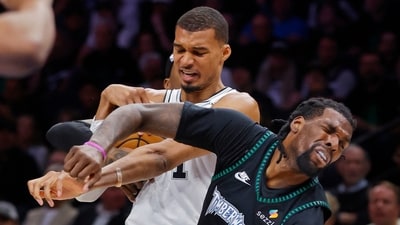
Victor Wembanyama may now face questions about a possible Game 5 suspension after the Spurs superstar was ejected during Sunday’s playoff showdown against the Timberwolves. The dramatic moment unfolded midway through the second quarter with Minnesota leading 36-34 and 8:39 remaining before halftime. Wemby fought for an offensive rebound while battling Jaden McDaniels and Naz Reid in the paint.

As McDaniels collided with him, Wembanyama spun toward the basket with his elbow raised and caught Reid hard in the chin. Officials immediately reviewed the sequence before upgrading the play to a Flagrant 2 foul, triggering an automatic ejection.
The ruling stunned the 22-year-old French star, who appeared confused during the stoppage. In a clip that eventually went viral on social media, Wemby was seen asking a staff member: “What does that mean? I’m ejected?”
“Victor Wembanyama didn’t realize a Flagrant 2 meant an automatic ejection,” one person wrote on X, platform formerly known as Twitter. Another one added: “Its simply idiotic.”
Why Wemby’s ejection matters
The ejection dramatically shifted momentum in a series San Antonio entered with a 2-1 advantage. Wembanyama had completely controlled Game 3, erupting for 39 points, 15 rebounds and five blocks in Friday’s Spurs victory.
His postseason dominance has already included a record-setting 12-block performance earlier in the matchup, making his absence in Game 4 even more significant.
Without the 7-foot-4 centerpiece protecting the rim, Minnesota suddenly gained far more freedom offensively. Wembanyama’s defensive presence has repeatedly disrupted the Timberwolves throughout the series, forcing attackers to alter drives and shots around the basket.
San Antonio still had offensive firepower available through De’Aaron Fox, Devin Vassell and Stephon Castle, but losing its franchise star before halftime completely altered the game’s dynamic.
Attention now shifts toward whether the NBA will impose additional punishment before Game 5. A Flagrant 2 does not automatically result in a suspension, though the league office can review dangerous plays involving head or throat contact and decide further discipline is necessary.